
Do Vacations Really Start on Day One?
We've all been there.
Vacation finally begins.
You close your laptop.
You turn on your out-of-office message.
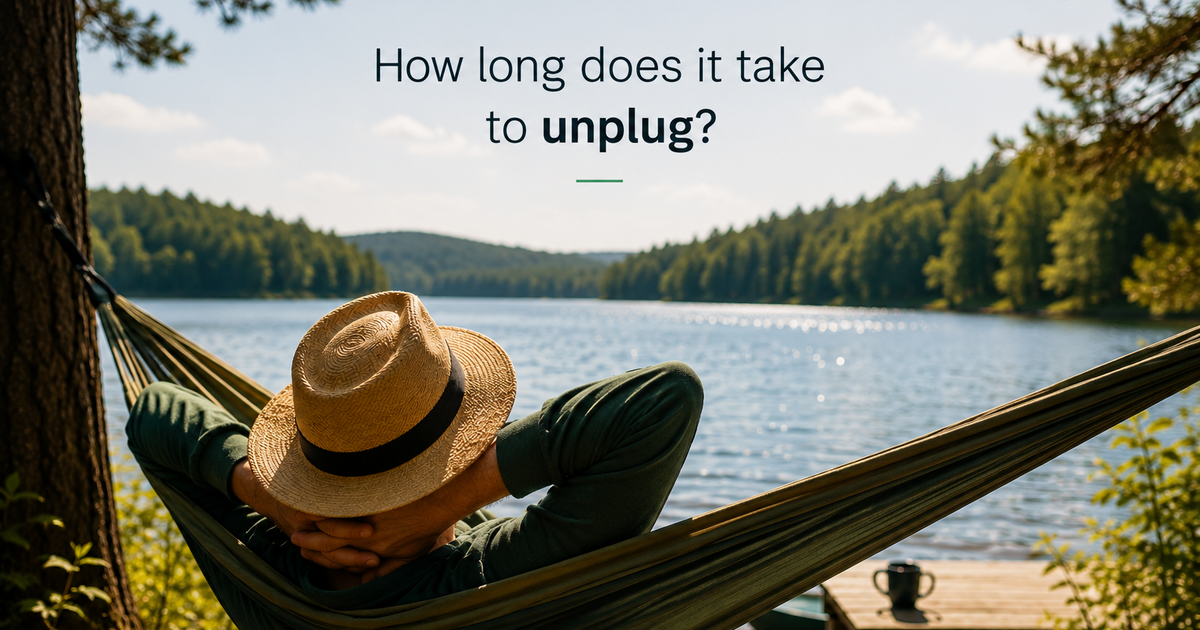
You head to the cottage, the campground, or the beach.
And yet...
For the first few days, work has a way of following you.
You think about the client who's still waiting for an answer.
The meeting scheduled for your first day back.
The project you hope doesn't fall apart while you're away.
Then, one morning, something changes.
You find yourself staring at the lake for several minutes.
You can't remember where you left your phone.
A completely new idea pops into your head.
It's almost as if your brain has finally realized...
You're actually on vacation.
As it turns out, this experience is far more common and far more scientific than most people realize.
-----------
Your Brain Doesn't Stop Working Just Because You're on Vacation
We often assume work ends the moment we leave the office.
Our brains don't work that way.
Psychologists refer to this as psychological detachment.
It's the ability to mentally disconnect from work once the workday is over.
It isn't just about ignoring emails.
It's about no longer replaying yesterday's meeting.
No longer trying to solve tomorrow's problem.
No longer planning next week's schedule without even realizing it.
Today, many researchers consider psychological detachment to be one of the most important recovery mechanisms after work.
In other words...
Your body can be on vacation long before your brain is.
--------------
The First Few Days Are Mostly About Slowing Down
This may be the most surprising finding.
Contrary to what many of us assume, the benefits of a vacation don't appear overnight.
A meta-analysis by Jessica de Bloom and her colleagues, combining evidence from multiple studies on vacations and well-being, found that vacations improve health, reduce exhaustion, and increase overall well-being. However, recovery is gradual, and some of those benefits begin to fade once people return to work.
Additional research from the same team found that several recovery indicators continue improving throughout a vacation and typically reach their highest levels around the eighth day.
That doesn't mean everyone follows the same timeline.
But it's a pattern that appears often enough to stand out.
If you've ever felt like your vacation only truly began...
Right before it was time to go home...
You're probably not the only one.
----------------
What's Happening Inside Your Brain?
There's another fascinating explanation.
In neuroscience, it's called the Default Mode Network (DMN).
The DMN is a network of brain regions that becomes especially active when our attention is no longer focused on a specific task.
In other words...
When we're walking.
Watching the flames of a campfire.
Sitting quietly by a lake.
Or simply letting our minds wander.
For years, scientists believed this network represented the brain at rest.
Today, we know it's anything but inactive.
The Default Mode Network plays an important role in self-reflection, autobiographical memory, imagining the future, solving complex problems, and perhaps most interestingly...
Creativity.
Researchers have even found that certain characteristics of the DMN are associated with stronger performance on creative thinking tasks.
In other words...
When you feel like you're doing absolutely nothing...
Your brain may actually be doing exactly what it needs.
------------
Your Best Ideas Rarely Happen During a Meeting
There's probably a reason so many entrepreneurs say their best ideas came...
In the shower.
On a hike.
Or while they were on vacation.
Once our attention is no longer consumed by deadlines, notifications, and constant decision-making, the brain regains something that's often missing from everyday life.
Space.
Space to connect ideas.
Space to look at a problem differently.
Space for a solution that probably never would have appeared between two Teams meetings.
Vacations don't automatically make us more creative.
But they recreate the conditions that allow creativity to return.
------------
What If Vacations Are About More Than Rest?
We often think of vacations as a reward.
A few days to recover before getting back to work.
Science tells a slightly different story.
The first few days often allow the brain to slow down.
Then, once it finally stops operating in constant work mode, it goes back to doing what it does best.
Thinking.
Imagining.
Making connections.
Perhaps the real question isn't:
"How many weeks of vacation do you take each year?"
But rather:
"Do you give your brain enough time to realize it's finally on vacation?"
--------------
Sources
- Syrek, C. J., de Bloom, J., & Lehr, D. (2021). Well Recovered and More Creative? A Longitudinal Study on the Relationship Between Vacation and Creativity. Frontiers in Psychology.
- de Bloom, J., et al. (2009). Do We Recover From Vacation? Meta-analysis of Vacation Effects on Health and Well-being. Journal of Occupational Health.
- Sonnentag, S., & Niessen, C. (2020). To Detach or Not to Detach? Frontiers in Psychology.
