
When Finding Became Easier Than Deciding
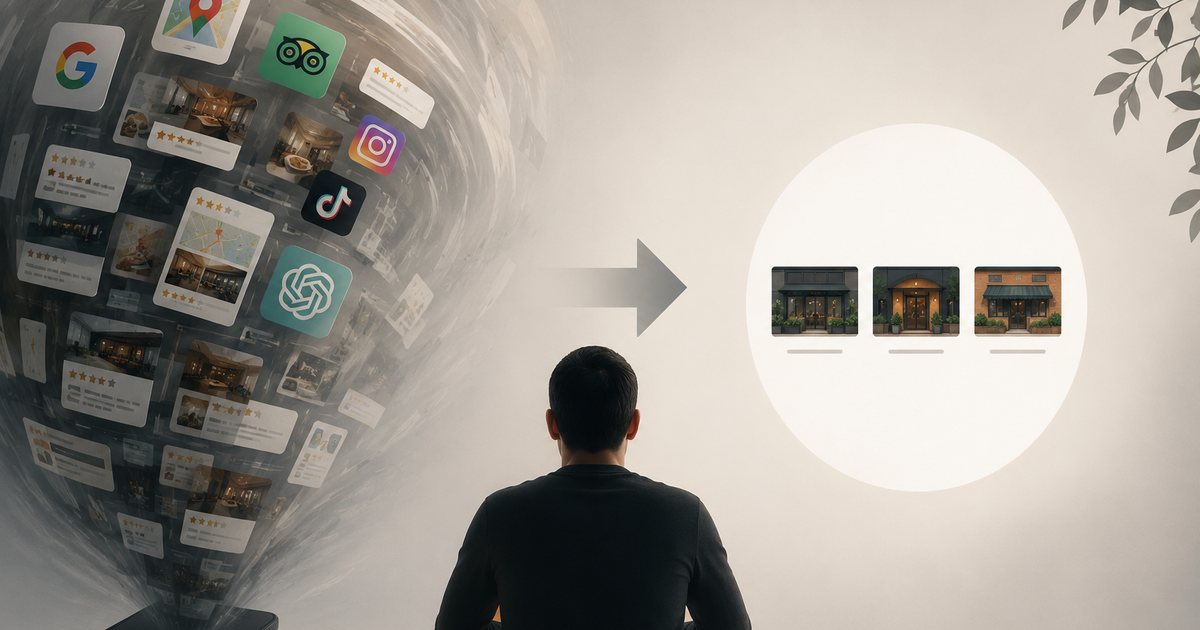
Technology was supposed to save us time. So why does making simple decisions feel harder than ever?
---
It's Friday afternoon.
You text a few friends.
"Dinner next week?"
The replies come quickly.
"Tuesday works."
"I'm only free Thursday."
"Somewhere with a patio."
"Not too expensive."
"Can we stay close to downtown?"
"Do you have a place in mind?"
You open Google.
Then Google Maps.
Then Tripadvisor.
Instagram.
TikTok.
Someone suggests asking ChatGPT.
It recommends ten restaurants.
You ask for something cozier.
Then something quieter.
Then something with easier parking.
Then somewhere that's good for groups.
Then somewhere under $40 a person.
Then somewhere with vegetarian options.
Then somewhere that still has availability on Friday.
Forty-five minutes later...
The most ironic part isn't that you still haven't chosen a restaurant.
It's that you haven't even started planning dinner.
You've only been planning your search.
---
We were promised a future where technology would save us time.
And, in many ways, it has.
Finding information has never been easier.
Finding restaurants.
Finding hotels.
Finding flights.
Finding suppliers.
Finding opinions.
Finding recommendations.
Almost every answer imaginable is now only a few clicks, or a single prompt, away.
Yet something feels strangely different.
Many of us spend less time searching than ever before.
But somehow, we spend more time deciding.
---
We often describe modern life as busy.
We say we don't have enough time.
That we're overwhelmed.
That our calendars are full.
Those things are true.
But what if they aren't the real problem?
What if the real issue isn't that we have too little time...
But that we've quietly transformed simple decisions into increasingly complex search processes?
---
For decades, we measured technological progress by one question:
How quickly can we find information?
Every major innovation pushed that answer further.
Search engines organized the web.
Maps organized places.
Review platforms organized opinions.
Social media organized recommendations.
Artificial intelligence now organizes knowledge itself.
Each breakthrough made searching faster.
More personalized.
More accessible.
More intelligent.
Yet almost none of them removed what comes next.
The comparing.
The filtering.
The second-guessing.
The endless question hiding behind every search:
"What if there's an even better option?"
---
This isn't just about restaurants.
It's about vacations.
Doctors.
Schools.
Software.
Hotels.
Photographers.
Conference venues.
Contractors.
Cars.
Even careers.
The internet solved one problem spectacularly.
It gave us access to almost unlimited information.
In doing so, it quietly created another.
Unlimited possibilities.
---
At first glance, that sounds like progress.
More options should mean better decisions.
More freedom.
More control.
For years, that's exactly what we believed.
Until psychologists started asking a different question.
What if more choices don't actually make us happier?
What if they simply make choosing harder?
That question would eventually become the foundation of one of the most influential books in behavioral psychology and it changed the way researchers think about human decision-making.
Barry Schwartz called it The Paradox of Choice.
---
Why Our Brains Were Never Designed for Infinite Choice
Barry Schwartz wasn't arguing against freedom.
He wasn't suggesting that fewer choices are always better.
His insight was far more subtle.
For decades, economists assumed that more options naturally led to better outcomes.
After all, if choosing between three restaurants is good, choosing between three hundred should be even better.
More freedom.
More competition.
Better decisions.
At least, that was the theory.
Reality turned out to be far more complicated.
---
Schwartz observed something that most of us have experienced without ever putting a name to it.
Every new option doesn't simply increase opportunity.
It also creates another comparison.
And every comparison comes with a hidden cost.
Mental effort.
One restaurant becomes five.
Five become twenty.
Twenty become fifty.
Suddenly, the challenge is no longer finding a place to eat.
It's evaluating dozens of possibilities that all seem... good enough.
Every additional possibility asks the same silent question:
"What if this isn't the best one?"
---
That's where something fascinating begins to happen.
The goal quietly changes.
We stop looking for a good decision.
We start searching for the perfect decision.
Not because perfection matters.
Because the abundance of information makes us believe perfection must exist somewhere.
Maybe it's one more Google search away.
One more review.
One more TikTok video.
One more AI prompt.
One more recommendation from a friend.
The finish line keeps moving.
---
Long before artificial intelligence arrived, psychologists already understood this phenomenon.
Today, technology has simply multiplied it.
Search engines gave us access to information.
Review platforms added opinions.
Social media added recommendations.
Artificial intelligence added synthesis.
Each innovation removed friction from searching.
None removed friction from deciding.
---
If Barry Schwartz explains why too many choices become exhausting...
Neuroscientist Daniel Levitin helps explain what happens inside our brains.
In The Organized Mind, Levitin describes the human brain as an extraordinary machine operating with surprisingly limited attentional resources.
Every notification.
Every comparison.
Every review.
Every recommendation.
None of them seems particularly demanding on its own.
Together, however, they compete for the same limited pool of cognitive energy.
The result is something researchers often describe as cognitive overload.
---
We tend to imagine decision-making as a purely rational exercise.
Compare the options.
Choose the best one.
Move on.
Our brains don't work that way.
Every decision consumes mental resources.
Psychologists sometimes refer to this gradual depletion as decision fatigue.
Not because decisions become impossible.
Because they become increasingly expensive.
The first comparison of the day feels effortless.
The fiftieth rarely does.
---
Think about what actually happens while planning something as ordinary as dinner.
You don't simply compare restaurants.
You compare neighborhoods.
Parking.
Prices.
Menus.
Dietary restrictions.
Opening hours.
Online reviews.
Photos.
Atmosphere.
Weather.
Travel time.
Availability.
Every variable seems reasonable.
Every variable seems small.
Until they accumulate.
Eventually, the difficulty isn't the restaurant.
It's the weight of hundreds of tiny decisions stacked on top of one another.
---
This explains something many of us have experienced.
After forty-five minutes of searching...
Every restaurant begins to look strangely similar.
The distinctions blur.
The excitement disappears.
The brain quietly shifts its objective.
No longer:
"What's the best choice?"
Instead:
"How do I end this process?"
---
That's why so many decisions end the same way.
We pick something that feels...
Good enough.
Not because it truly is.
Because our cognitive energy has been spent long before the decision itself.
Ironically, the very tools designed to simplify our lives often leave us mentally exhausted before we've accomplished the thing we wanted to do in the first place.
We wanted to organize dinner.
Instead, we organized information.
---
Perhaps that's the hidden cost of modern technology.
Not the time it takes to search.
The energy it takes to decide.
And that raises an even more interesting question.
If making decisions has become so cognitively demanding...
Why do we continue putting so much effort into experiences that are supposed to bring us closer together?
Or perhaps the better question is this:
Are those experiences precisely the ones worth protecting?
---
The Things That Matter Most
For nearly nine decades, researchers at Harvard University have been asking one deceptively simple question:
What makes a good life?
Not a successful life.
Not a wealthy life.
Not a productive life.
A good one.
The Harvard Study of Adult Development, launched in 1938, has followed multiple generations of participants through careers, marriages, failures, illnesses, achievements, and retirement.
Very few studies have lasted this long.
Even fewer have remained so remarkably consistent.
Its conclusion has surprised generations of researchers.
Money matters.
Health matters.
Career success matters.
But none of them predicts long-term happiness as powerfully as the quality of our relationships.
Strong relationships.
Meaningful conversations.
Shared experiences.
The simple act of spending time with people we care about.
---
Think about that for a moment.
The very moments that contribute most to our well-being...
Family dinners.
Weekend getaways.
Team celebrations.
Birthdays.
Holiday gatherings.
Community events.
They're also the moments that often require the most planning.
The most coordination.
The most searching.
The most comparing.
The most deciding.
Perhaps that's why they're so easy to postpone.
Not because they aren't important.
Because organizing them feels like work.
---
Modern technology has solved countless problems.
It allows us to communicate instantly.
Work remotely.
Access virtually unlimited knowledge.
Generate ideas in seconds.
Ask increasingly sophisticated AI assistants almost anything.
These are extraordinary achievements.
But they can also create an illusion.
We often confuse access to information with progress.
They're not the same thing.
Information tells us what's possible.
Progress removes unnecessary effort.
---
For decades, we measured technology by how much information it could provide.
Search engines indexed the web.
Review platforms collected opinions.
Artificial intelligence now summarizes almost everything.
Each generation has become remarkably better at answering questions.
But answering questions isn't always the hardest part.
Sometimes, the hardest part begins after the answer.
Choosing.
Coordinating.
Following up.
Confirming availability.
Making a decision.
Turning information into action.
---
Perhaps that's why so many people feel busier today than ever before.
Not necessarily because they have more work.
But because every decision now arrives surrounded by endless possibilities.
Every possibility invites another comparison.
Every comparison demands another small investment of attention.
None of these moments feels significant.
Together, they quietly consume our day.
And unlike money...
Attention is one of the few resources we never get back.
---
Maybe we've been asking technology the wrong question.
For years, we've asked:
"Can you help me find what I'm looking for?"
Increasingly, perhaps the better question is:
"Can you help me stop looking?"
Not by making decisions for us.
But by removing everything that doesn't deserve our attention in the first place.
By reducing unnecessary work.
By reducing unnecessary comparisons.
By reducing unnecessary cognitive load.
Because deciding becomes surprisingly easy when every remaining option already fits your needs.
Available.
Relevant.
Worth considering.
Sometimes progress isn't about creating more possibilities.
Sometimes it's about removing the wrong ones.
---
Perhaps that's where the next chapter of technology begins.
Not with more information.
Not with faster search.
Not even with better artificial intelligence.
But with something much simpler.
Helping people reclaim their attention.
Helping people reclaim their time.
Helping people focus on what actually matters.
Because no one ever wanted to spend an hour comparing restaurants.
We wanted to enjoy dinner with friends.
No one dreams of comparing hotel reviews for an entire evening.
They dream about the trip.
No manager wakes up excited to compare dozens of suppliers.
They care about creating memorable experiences for their team.
The search was never the goal.
Life was.
---
Perhaps that's the greatest paradox of our digital age.
We've built technologies capable of answering almost every question imaginable.
Yet we're still searching for something much simpler.
The feeling that our time belongs to us again.
Technology should do more than inform us.
It should give us time back.
---
Sources
Barry Schwartz. The Paradox of Choice: Why More Is Less. Harper Perennial, 2004.
Daniel J. Levitin. The Organized Mind: Thinking Straight in the Age of Information Overload. Dutton, 2014.
Harvard Study of Adult Development. Harvard University. One of the world's longest-running longitudinal studies on adult well-being.
