
The Web Helped Us Find Things. Now It Wants to Take Action for Us.
For more than 25 years, our relationship with the web has followed a familiar pattern.
We need something. We open a search engine. We type a few keywords. Then the real work begins: opening tabs, reading, comparing, reaching out, waiting for replies, following up… and sometimes starting all over again.
Artificial intelligence has already started to change that experience. Instead of simply giving us a list of links, AI can now process information, summarize it and give us an answer.
But a much bigger shift may be underway.
What if, instead of asking the web what we should do, we could simply ask it to do the work?
Microsoft Research describes this evolution as the transition from Search Engines to Action Engines.
The potential is enormous.
So are the challenges.
----------
From search, to answers, to action
In June 2025, Microsoft Research published a paper with a particularly telling title: From Search Engines to Action Engines.
The idea is relatively simple.
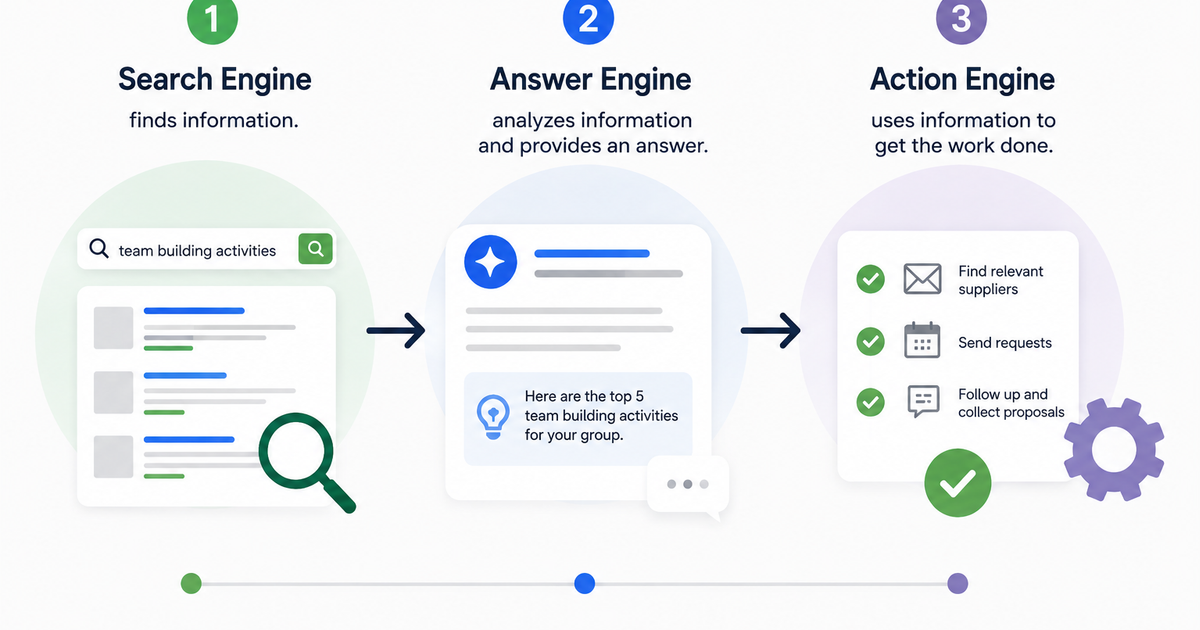
Search engines gave us access to information. Generative AI is increasingly giving us answers built from that information. The next frontier is task completion: systems that can move beyond telling us what to do and actually take steps toward achieving an objective.
Think of the evolution this way:
Search Engine → finds information.
Answer Engine → analyzes information and provides an answer.
Action Engine → uses information to get work done.
That last step changes a lot.
Asking, “What are some good restaurants for a group of 40 people in Montreal?” and receiving five recommendations is an answer.
Finding the relevant restaurants, sending them your requirements, checking their interest, following up and coming back with actual proposals is an action.
In the first scenario, technology helps you start the work.
In the second, it actually does part of the work.
----------
This may be where AI’s biggest productivity gains are hiding
Much of the conversation around generative AI has focused on helping us produce things faster.
Write an email. Summarize a document. Build a presentation. Analyze a spreadsheet.
Those productivity gains are real.
But much of our digital workday is still made up of small, repetitive actions.
Search. Click. Copy. Compare. Fill out. Send. Wait. Follow up.
Individually, none of these tasks feels particularly significant. Across a week, a month or an entire organization, they add up to an enormous amount of time.
That is what makes the idea of Action Engines so interesting.
Their potential isn't simply to help us perform a task faster.
It's to make some of those steps no longer ours to perform at all.
That's a fundamentally different productivity proposition.
But there is still a significant gap between understanding what someone wants and reliably getting it done in the real world.
----------
Acting on the web is much harder than talking about it
WebArena offers a good illustration of just how difficult that can be.
Presented at ICLR 2024, the benchmark was designed to test AI agents against realistic web tasks involving environments such as e-commerce, forums, content management and collaborative software.
Instead of asking agents questions, researchers asked them to complete actual multi-step tasks.
The best GPT-4-based agent evaluated in the original study successfully completed just 14.41% of end-to-end tasks, compared with 78.24% for humans.
That's a substantial gap.
Of course, those numbers need context. They reflect a particular benchmark, architecture and moment in the development of AI agents. This technology is moving extremely quickly.
How quickly?
In February 2026, Microsoft Research introduced ActionEngine, an architecture designed to help agents remember the structure of an interface and reuse successful action patterns rather than reasoning through every screen from scratch.
On a set of Reddit tasks from WebArena, Microsoft researchers reported a 95% success rate, compared with 66% for their strongest vision-only baseline. They also reported an 11.8× reduction in cost and roughly 2× lower end-to-end latency.
It would be misleading to directly compare that 95% with WebArena's original 14.41%. The systems, experimental conditions and task subsets are different.
But together, they illustrate something important.
We're still early. And progress is happening very, very quickly.
----------
A wrong answer and a wrong action are not the same thing
This may be the most important challenge in the transition from search to action.
A search engine can recommend the wrong restaurant.
You close the tab.
An Action Engine could potentially book the wrong restaurant.
Suddenly, reliability means something very different.
The more authority we give a system to act on our behalf, the more we need to define what it can do independently and what should still require human approval.
Can it send an email?
Change a reservation?
Accept a proposal?
Make a payment?
Share information with a third party?
And perhaps most importantly: what happens when it gets something wrong?
The challenge isn't only the intelligence of the model itself.
The web wasn't originally designed for autonomous AI agents. Changing interfaces, pop-ups, authentication requirements, CAPTCHA, permissions and ambiguous information can turn a seemingly straightforward task into a complex sequence of decisions.
Microsoft has acknowledged this challenge in its own work on agentic browsing, noting that giving AI agents the ability to act directly within browsers introduces new security considerations and requires additional safeguards.
Knowing how to act isn't enough. An Action Engine also needs to know when to act, when to verify… and when to let a human decide.
----------
The future may not be one AI agent that does everything
The popular vision of AI agents is often an all-purpose digital assistant.
Give it an objective and let it handle everything.
It's an appealing idea.
But the Action Engines that create the most value in the near term may actually be much more specialized.
A system designed around a specific category of work can understand its environment, the information it needs, the actions it is allowed to take, the exceptions it may encounter and, crucially, the points where human judgment should take over.
Research into Large Action Models (LAMs) is exploring exactly this shift: moving beyond models primarily designed to generate language toward systems capable of generating and executing actions in dynamic environments. Researchers also highlight significant challenges that remain around grounding, integration and evaluation before these systems can be deployed reliably at scale.
In other words, the goal may not be to remove humans from the equation.
It may be to remove the unnecessary work surrounding human decisions.
----------
Automate the work. Not the judgment.
That's also the thinking behind what we're building at KEHOPS.
When a company needs a venue for a holiday party, an activity for an offsite, a caterer or an HR provider, the problem usually isn't a lack of information.
The web already has plenty of it.
The problem is everything that comes after finding that information.
Identifying relevant suppliers. Reaching out. Explaining the need. Following up. Waiting for responses. Gathering proposals.
With KEHOPS, an organization publishes its need once. The platform automates those steps and brings the proposals back together in one place.
But it doesn't make the final choice for you.
Because there is an important difference between automating the work required to reach a decision and outsourcing the decision itself.
And that may become one of the defining questions of the next generation of the web.
For years, technology helped us find.
Then it learned to answer.
Now, it's beginning to act.
The biggest question may not be how far the technology can go.
It may be how far we want to let it.
Automate the work. Not the judgment.
----------
References
Microsoft Research (2025) — From Search Engines to Action Engines. IEEE Computer, Vol. 58, No. 6, pp. 59–68.
Zhou, S. et al. (2024) — WebArena: A Realistic Web Environment for Building Autonomous Agents. International Conference on Learning Representations (ICLR 2024).
Microsoft Research (2026) — ActionEngine: From Reactive to Programmatic GUI Agents via State Machine Memory.
Wang, L. et al. — Large Action Models: From Inception to Implementation.
Microsoft Edge Security (2025) — Considerations for Safe Agentic Browsing.
