
The Evolution of Web Search: From Search Engines to Intelligent Reverse Sourcing
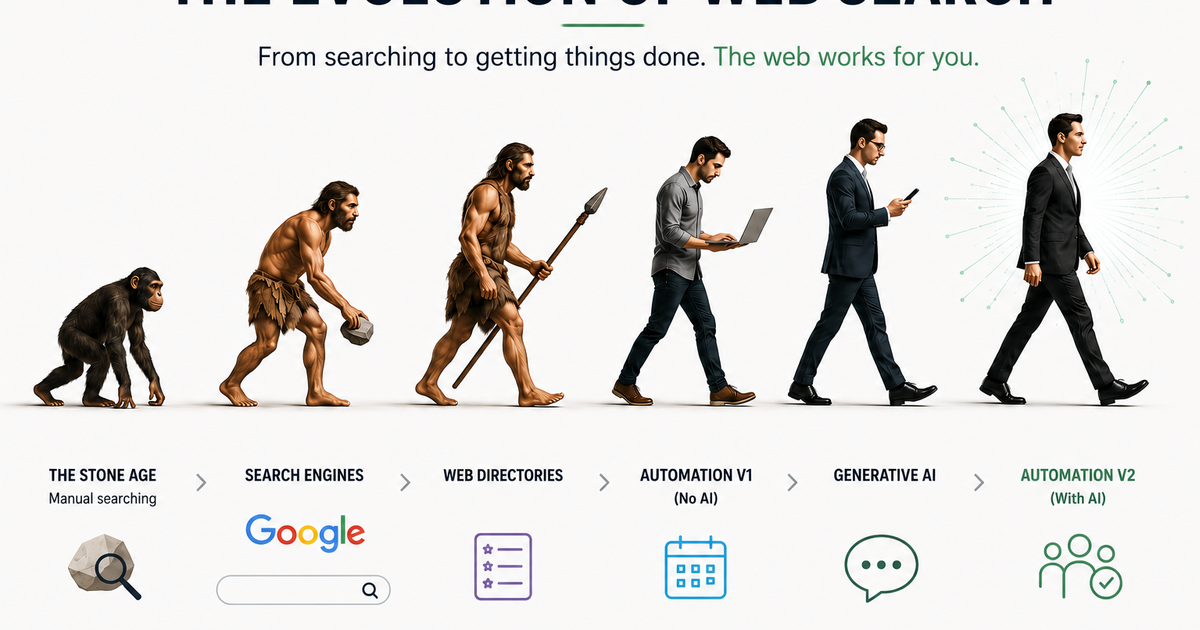
For 30 Years, We've Been Searching
For nearly three decades, the Internet has taught us one thing: how to search.
- Search for information.
- Search for a product.
- Search for a hotel.
- Search for a restaurant.
- Search for a supplier.
For years, the faster we could search, the more advanced the technology seemed.
But something is changing.
People no longer want to simply find information.
They want the work to be done.
This shift is gradually transforming the way we interact with the web.
---
First Generation: Search Engines
In the late 1990s, search engines such as:
- Bing
- Yahoo!
revolutionized the Internet.
Their mission was simple: Organize the world's information.
Users entered a search query. The search engine returned a list of links. From that point on...The real work began.
Users still had to:
- open multiple websites;
- compare information;
- take notes;
- go back;
- search again.
Google dramatically reduced the time required to find information.
But it never eliminated the work that comes after the search.
---
Second Generation: Specialized Directories
Over time, specialized directories began to emerge.
For example:
- Yelp
- TripAdvisor
- Yellow Pages
- WeddingWire
- Bark
- Houzz
Their approach was different.
Instead of indexing the entire web, these platforms focused on a specific category of suppliers.
The result?
- Less searching.
- Customer reviews.
- Powerful filters.
- A better user experience.
Yet users still had to:
- search;
- open multiple listings;
- contact several suppliers.
The sourcing process remained largely manual.
---
Third Generation: Conversational AI
The arrival of ChatGPT, Claude, Gemini, Copilot, and Perplexity marked a major turning point. For the first time, users no longer received only a list of links.
They received direct answers.
AI can:
- summarize;
- explain;
- recommend;
- compare.
Search has become far more conversational. It is a significant breakthrough.
However, in most cases, users still need to:
- contact businesses;
- request quotes;
- follow up;
- compare proposals.
In other words, AI dramatically reduces search time...but not the execution time that follows.
---
Fourth Generation: Automation
For several years now, certain platforms have already automated parts of the customer journey.
For example:
Expedia automates:
- hotel search;
- availability;
- booking.
Booking.com automates:
- reservations;
- payments.
OpenTable automates:
- restaurant reservations.
SalleMTL simplifies the discovery of event venues in Montreal.
These platforms represent the first generation of automation. They perform exceptionally well when:
- products are standardized;
- availability is known;
- transactions are simple.
However, they reach their limits when needs become more complex.
For example: Organizing a team-building event for 75 people that requires a restaurant, an activity, catering, and accommodations.
In these situations, significant research and coordination are still required.
---
The Next Step: Intelligent Reverse Sourcing
A new approach is beginning to emerge. Instead of searching for suppliers yourself...
Why not let the right suppliers available, qualified, and interested in your specific needs come to you?
This is what we call Intelligent Reverse Sourcing.
The concept is simple. Instead of performing dozens of searches, users describe their needs only once.
The platform then:
- identifies the most relevant suppliers;
- automatically distributes the request;
- follows up with suppliers;
- centralizes proposals;
- presents every response in one place.
The job is no longer to search.
The job is simply to choose.
---
Why This Evolution Makes Perfect Sense
This evolution perfectly reflects changing consumer expectations. For years, innovation focused primarily on making search faster. Today, expectations are different.
People want to:
- click less;
- compare less;
- coordinate less;
- wait less.
The most valuable platforms are no longer the ones that provide the most information. They are the ones that eliminate the most steps.
---
A Pattern We've Already Seen
Uber didn't reinvent taxis. It automated the experience.
Netflix didn't invent movies. It automated access to them.
Spotify didn't invent music. It automated discovery.
The evolution of web search follows exactly the same pattern. First came search engines. Then came artificial intelligence. The next logical step is to automate everything that happens after the search.
---
KEHOPS: An Example of Intelligent Reverse Sourcing
KEHOPS is part of this emerging category.
Instead of asking organizations to search for restaurants, event venues, caterers, team-building activities, speakers, accommodations, or HR partners, the platform automates supplier discovery, outreach, follow-ups, and proposal collection.
The goal is no longer simply to help users find suppliers. The goal is to help them spend their time on their priorities instead of performing dozens of web searches and manual follow-ups.
---
Conclusion
For nearly 30 years, the web has taught us how to search.
Artificial intelligence is now teaching us how to get answers.
The next revolution may be even more ambitious: Stop searching. Stop coordinating. Simply publish your need... and let the web do the work for you.
